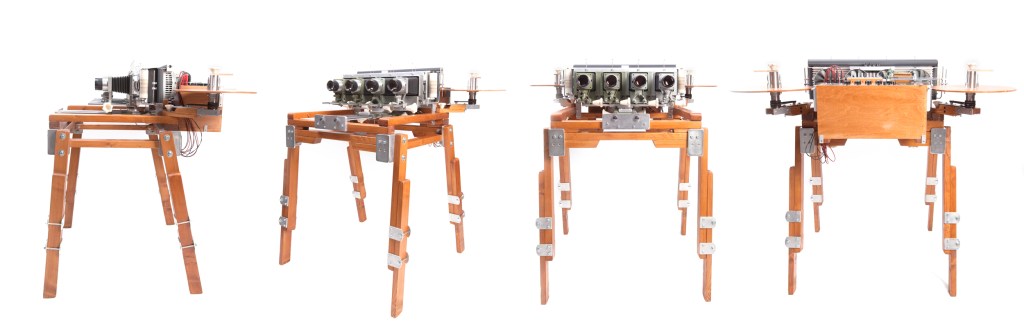
The Archeoscope is an opto-mechanical special projecting apparatus for live film performances, invented and constructed by Czech filmmaker Jan Kulka.
Its English name is derived from two Greek words: arché and skopeo. Arché, meaning “beginning”, “origin”, “ultimate underlying substance” or even “ultimate indemonstrable principle”, and skopeo, meaning “to observe”, “to look at”, “inspect”, “consider”, “contemplate”, or “examine”. Its Czech name, Pramítačka, refers to prehistoric times: the Czech word for projector – promítačka – turns into pramítačka – where the prefix “pra” is close to the English “pre”, with connotations of prehistory, of the ancient. A literal translation could therefore be Prejector.
At the beginning was the age-old primary question: What is film? What is the true essence of film? What are it’s expendable, indispensable and unique elements? The answer embodied in the foundations of the Archeoscope is: film is the articulation of light. And if cinematography is primarily the articulation of light, what are the consequences for film as we know it?
Each body determines both the possibilities and the limitations of its occupant. The Archeoscope was constructed in order to investigate, experiment with and experience the essential aspects of cinematographic phenomena. To observe in practice the nature of the relationship between creative process and technology. Between the apparatus and its operator. To examine how the technologies we use influence and determine the way we work, operate, create. In other words: to actively and practically reconsider and rethink various consequences of the established tradition. These thoughts are inspired by Vilém Flusser, among others. All this is done in a playful way, experimenting with the body of the film.
Technical standards are indeed a useful canon, especially for the efficiency of a large scale production, but at the same time, they impose rigid limitations on the hypothetically boundless ways of articulating light. So the next key question in this game is: What if?
What if there was no such thing as a fixed regular frame rate? No intermittent film transport mechanisms, or image ‘frame’? Or even better: what if the main aim of cinematography was no longer simply just the reproduction of movement, no longer just mediation of the ‘theatrical’ or ‘logos-based’ arts? After all, film can be much more than just an illusion of motion – what about the real movement?
Of course, none of these questions are in fact new. And all of them are calling for practical investigation. Even more so in our present situation – that is, in the context of the digitalisation of cinematography and the omnipresence of computing technologies. Even more so, when significant technological development in the area of opto-mechanical (analogue) projectors came to a stop nearly four decades ago. We have many potentially game changing elements in the technological area. Also the question of materiality – working with non-virtual media – is completely different, than let’s say fifty years ago. With media archeologist Siegfried Zielinsky – it is much better to find the new in the old, rather than the old in new.
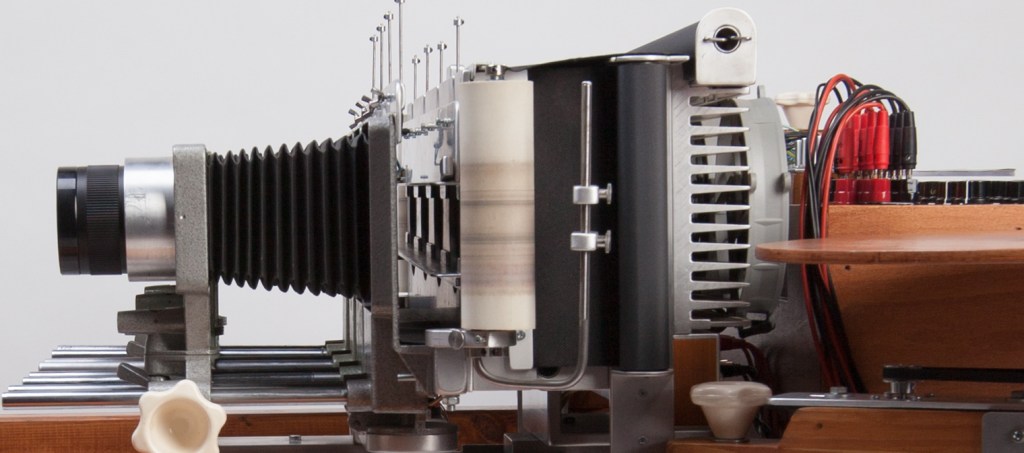
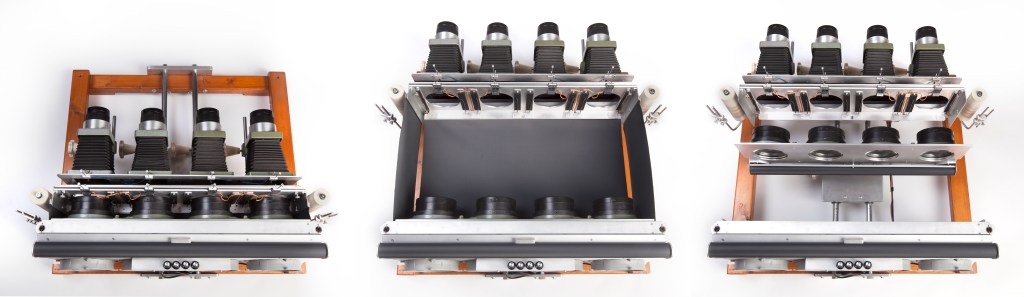
The Archeoscope can project all standard film formats (8, 16, 35, 70 mm etc.), but also various types of materials up to 14 cm wide (transparent tapes, bandages, laces, fabrics, wrapping tapes, bubble wraps barricade tapes, etc.). It has four independent light sources and four optical systems. These make it possible to project four different areas of a film strip at the same time. Each light can be turned on and off in three different ways: ‘metronomically’, with precisely adjustable durations of on/off times; through an optical cyclic sequencer, or via optically read impulses (marks/dots) on the film strip. There are therefore countless combinations and possible rhythms or polyrhythms in which each light can be activated. The frame rate is no longer fixed to a regular monotonous pattern, but can become free as music itself – it can be composed into shorter cyclic structures, or into larger linear time frames, as well as tuned into steadily interfering frequencies. All of these methods of orchestrating the lights can be run simultaneously.
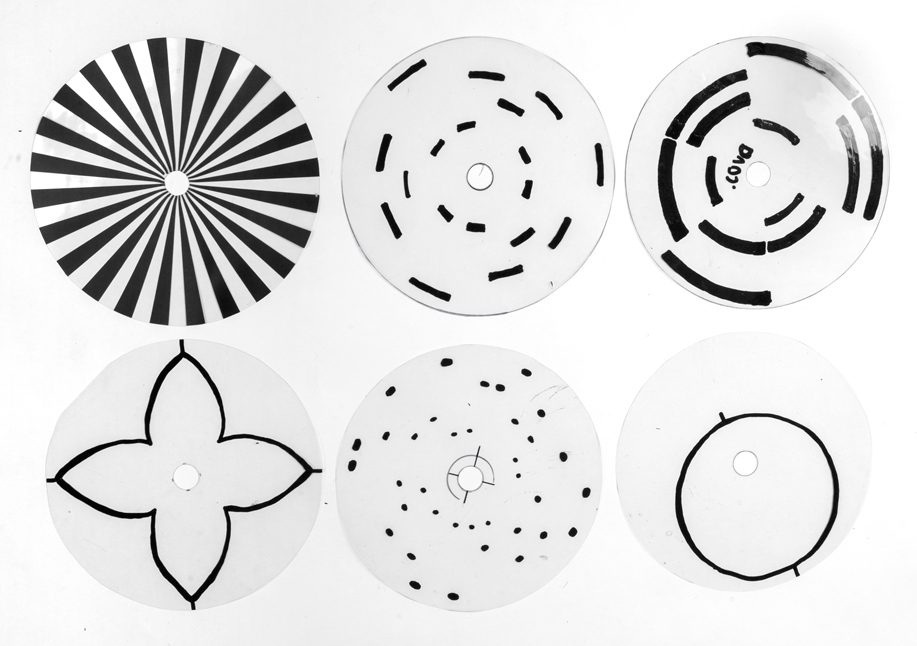
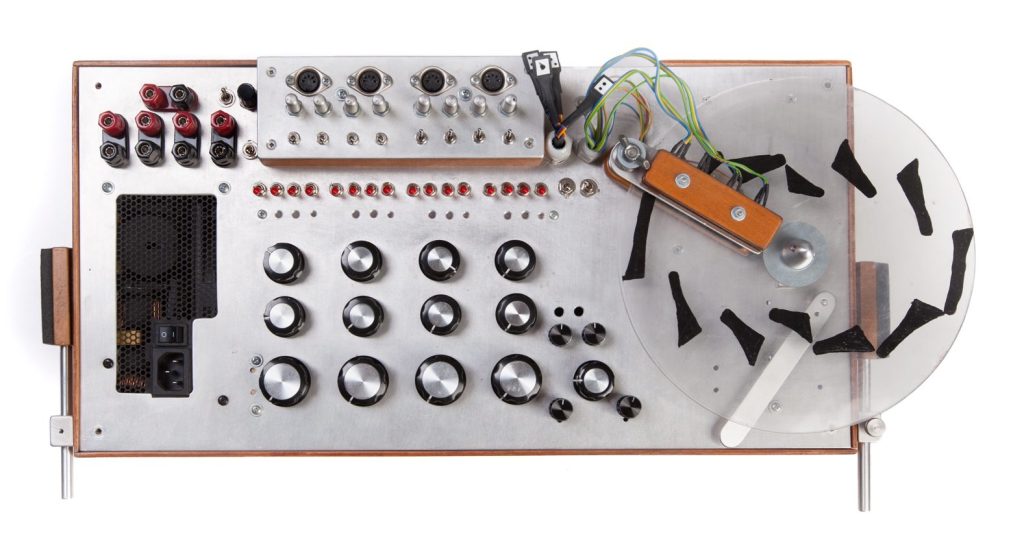
These properties bring brand new possibilities and radically different ways of looking at, understanding and working with film material, the act of projection and the entire creative process. For instance: one ‘luminous image’ on screen can consist of four different ‘luminous layers’ physically constituted from 4 different areas of film, so the concept of a single film frame is no longer axiomatic.
It is also important to note that the only way to witness – to actually, truly see – a projection of the Archeoscope is to physically come and attend a live screening – an event with the physical presence of the apparatus and its operator – and see it with one’s own naked eyes.
This is not only due to fact that each projection of any particular Archeoscope film is never absolutely identical, as it is a live projection, but it is also literally technically impossible to capture and reproduce the projection in the way it looks immediately to the human eye. In fact, seeing a hypothetical video recording of the projection is a fundamentally misleading experience. A major factor from a techno-physiological point of view is the multiple-variable-frame-rate of the apparatus in conjunction with the complexity of human vision, and its contrast and interference with the rigidly fixed frame rates of basically any kind of common camera. That all makes it impossible to transfer such kind of projection onto fixed media. Furthermore lots of what is provoked by Archeoscope projection is based in subjective vision phenomena and various phantom sensations.
In the context of the ubiquitous, endless and rapidly growing virtual world-wide archive of almost any thinkable content, including the realm of moving images, the Archeoscope contradicts this trend and stays aside. It voluntarily gives up the opportunity to be ‘everywhere’ and deliberately chooses to be in only one place at a time. In exchange for this sacrifice, it can honestly claim to provide a truly unique and exclusive experience for each spectator present. An experience which cannot be substituted by anything else, as there is only one prototype of this special projecting apparatus cruising through the universe.
It also stands separate from the normal systems of film distribution. The projection can take place at all kinds of venues: cinemas, galleries, theatres, but also at any attic, basement, village barn, swamp or forest. It can therefore encounter and reach many different social groups, which is also an important and a precious aspect of this concept.
The Archeoscope (Pramítačka) is an attempt to reach a deeper independence in cinematography. Freedom in the context of the film industry and film distribution, but also in terms of technological limitations and possibilities. It is an attempt to control as much of these conditional attributes as possible, and to work with them knowingly and creatively, incorporating them into the complex creative process in a playful game-like process. An application of media archaeology in practice. Serious, conscious and light-hearted at the same time. Articulating light as it hasn’t been articulated before.
